What to Expect When You Contact Us?
-
USCIS Policy Manual, Chapter 2 – Definition of Child for Citizenship and Naturalization
-
USCIS Policy Manual, Chapter 3 – United States Citizens at Birth (INA 301 and 309)
-
USCIS Policy Manual, Chapter 4 – Automatic Acquisition of Citizenship after Birth (INA 320)
-
USCIS Policy Manual, Chapter 5 – Child Residing Outside of the United States (INA 322)
-
USCIS Policy Manual, Chapter 2 – Definition of Child for Citizenship and Naturalization
-
USCIS Policy Manual, Chapter 3 – United States Citizens at Birth (INA 301 and 309)
-
USCIS Policy Manual, Chapter 4 – Automatic Acquisition of Citizenship after Birth (INA 320)
-
USCIS Policy Manual, Chapter 5 – Child Residing Outside of the United States (INA 322)

Restoring Human Dignity
O.R.P.E.- Order for Restoring Peace on Earth

Cooperative Enterprise Systems for Sustainable Community Empowerment (CES-SCE)
An Integrated Model for Economic Dignity, Legal Empowerment, and Local Governance Transformation

If:
-
Communities are organized into cooperative enterprises
-
Individuals gain legal knowledge and access to justice
-
Local governance systems are made participatory and accountable
Then:
-
Economic independence increases
-
Rights violations decrease
-
Civic participation strengthens
Leading to:
-
Sustainable community transformation
-
Institutional reform from the bottom-up
-
Restoration of human dignity
Theory of Change
PROGRAM COMPONENTS / ACTIVITIES
Component 1:
Cooperative Enterprise Development
-
Community mobilization and cooperative formation
-
Business planning and governance structuring
-
Sector focus:
-
Agriculture value chains
-
Micro-manufacturing
-
Service cooperatives
-
Activities:
-
Cooperative registration support
-
Financial literacy training
-
Seed capital and revolving funds
Component 3:
Governance and Accountability
-
Community oversight committees
-
Social accountability platforms
-
Public expenditure tracking
Activities:
-
Town hall forums
-
Participatory budgeting
-
Civic engagement campaigns
Component 2:
Legal Empowerment Systems
-
Rights education workshops
-
Training of community paralegals
-
Legal aid referral networks
Activities:
-
Legal clinics
-
Case documentation systems
-
Dispute resolution mechanisms
Component 4:
Market Systems & Financial Inclusion
-
Value chain integration
-
Digital marketplace platforms
-
Access to microfinance and cooperative banking
Activities:
-
Buyer-seller linkage forums
-
Mobile banking adoption
-
Cooperative branding and certification
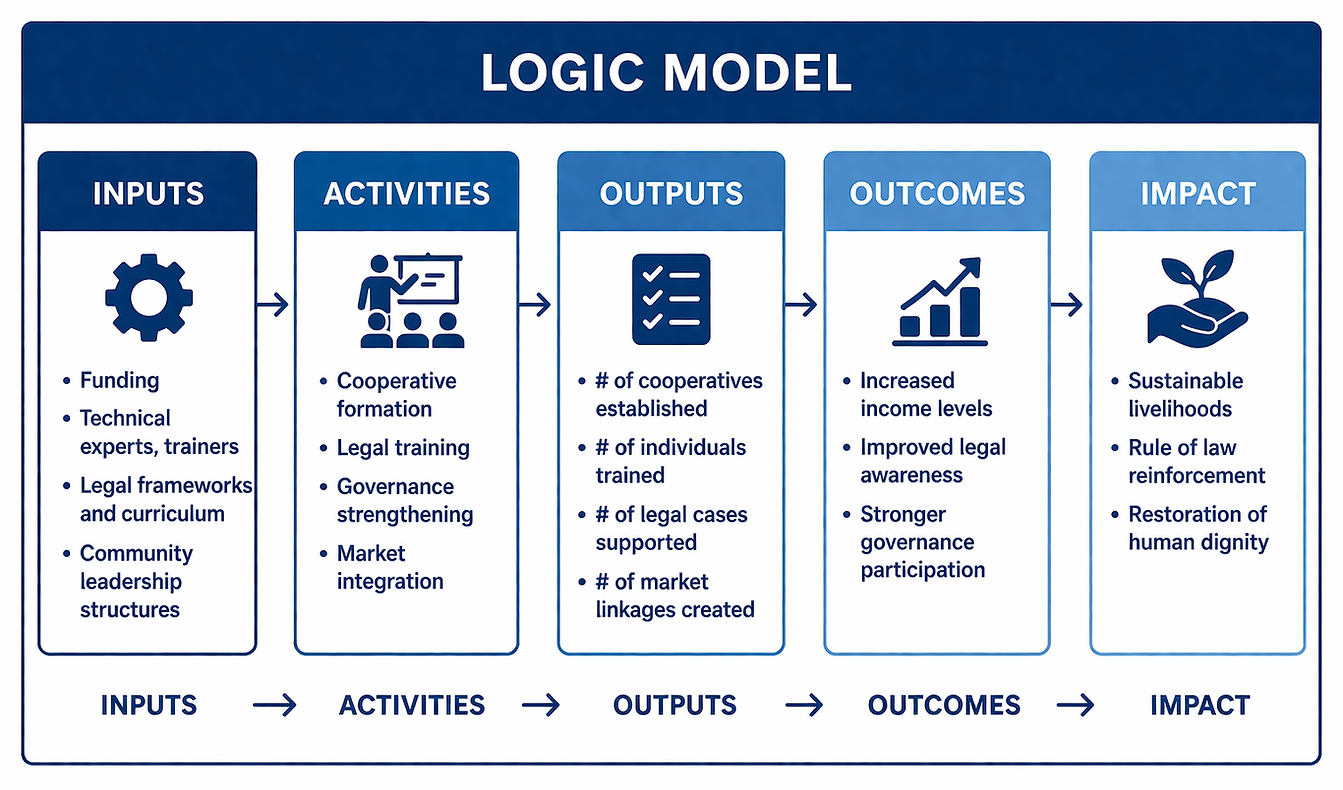


MONITORING & EVALUATION (MEL)
Key Performance Indicators (KPIs)
Economic Indicators
-
% increase in cooperative member income
-
Cooperative profitability rates
Legal Indicators
-
% increase in legal awareness
-
of disputes resolved through legal systems
Governance Indicators
-
Participation rates in local governance
-
Transparency score improvements
Data Collection Methods
-
Baseline and endline surveys
-
Quarterly performance tracking
-
Digital dashboards (real-time KPI monitoring)
-
Case studies and qualitative assessments
Evaluation Framework
-
Mid-term evaluation (Month 24)
-
Final impact evaluation (Month 48)
-
Third-party verification (donor compliance)
SUSTAINABILITY STRATEGY
Economic Sustainability
-
Self-financing cooperatives
-
Revolving loan funds
-
Market-driven revenue streams
Institutional Sustainability
-
Community-owned governance systems
-
Integration with local government structures
Capacity Sustainability
-
Train-the-Trainer (ToT) model
-
Local leadership development
Legal Sustainability
-
Embedded paralegal networks
-
Partnerships with legal institutions
RISKS AND ASSUMPTIONS
Key Risks
Political Risk
-
Resistance from entrenched power structures
Economic Risk
-
Market volatility affecting cooperative viability
Social Risk
-
Community fragmentation or elite capture
Operational Risk
-
Limited local capacity
Mitigation Strategies
-
Stakeholder engagement at all levels
-
Diversified income streams
-
Strong governance frameworks within cooperatives
-
Continuous capacity building
Core Assumptions
-
Communities are willing to participate collectively
-
Legal frameworks allow cooperative formation
-
Markets exist for goods/services produced
-
Donor and institutional support is sustained
Program Positioning (Donor Alignment)
This program aligns with:
-
USAID: Economic growth, democracy & governance
-
UNDP: Inclusive development, rule of law
-
EU: Human rights, civil society strengthening
Strategic Value Position
Unlike traditional development models, CES-SCE:
-
Integrates economic + legal + governance systems
-
Builds community ownership, not dependency
-
Produces measurable rule-of-law outcomes
-
Scales through replicable cooperative ecosystems