What to Expect When You Contact Us?
-
USCIS Policy Manual, Chapter 2 – Definition of Child for Citizenship and Naturalization
-
USCIS Policy Manual, Chapter 3 – United States Citizens at Birth (INA 301 and 309)
-
USCIS Policy Manual, Chapter 4 – Automatic Acquisition of Citizenship after Birth (INA 320)
-
USCIS Policy Manual, Chapter 5 – Child Residing Outside of the United States (INA 322)
-
USCIS Policy Manual, Chapter 2 – Definition of Child for Citizenship and Naturalization
-
USCIS Policy Manual, Chapter 3 – United States Citizens at Birth (INA 301 and 309)
-
USCIS Policy Manual, Chapter 4 – Automatic Acquisition of Citizenship after Birth (INA 320)
-
USCIS Policy Manual, Chapter 5 – Child Residing Outside of the United States (INA 322)

Restoring Human Dignity
O.R.P.E.- Order for Restoring Peace on Earth
How We're Run
01
Board Governance Manual
02
Financial Management & Internal Controls Manual
03
Enterprise Risk Management
04
MEL + Logframe System with KPIs and indicators
05
Anti-Corruption & Whistleblower System
ORPE's Operational System Architecture
To achieve rapid, measurable, and verifiable results, ORPE Human Rights Advocates employs an operational framework that translates its doctrine of truth-driven leadership into structured, accountable, and evidence-based programming. This approach ensures that principles are systematically converted into implementation, implementation into verified data, and verified data into demonstrable impact and public trust. The proposed program is therefore designed as a results-oriented system, integrating clear governance controls, rapid deployment mechanisms, real-time monitoring, and independent verification processes. Together, these components enable ORPE to deliver timely, transparent, and measurable improvements in human dignity outcomes while maintaining full compliance with performance, accountability, and reporting standards.
PRINCIPAL COMPONENTS:
GOVERNANCE & DOCTRINE ENGINE (GDE)
Controls how decisions are made and enforce
Truth-Driven Decision Protocol
(Mandatory System)
A standardized decision filter applied to all actions:
Operational Tool:
-
Decision Checklist (required before action approval):
-
Dignity impact defined (who, how, measurable)
-
Evidence basis identified (data/testimony)
-
Accountability owner assigned (named individual)
-
Why it matters:
-
Prevents “mission drift” and ensures every action is traceable and defensible.
Governance Oversight Unit
Functions:
-
Ethics compliance review
-
Incident escalation
-
Safeguarding enforcement
Deliverable:
Monthly Accountability & Integrity Report
Accountability Chain Mapping System
Every activity must have:
-
Responsible person (R)
-
Approving authority (A)
-
Implementing team (I)
-
Verifying unit (V)
Output:
A Responsibility Matrix (RACI+) tied to each program.
RAPID EXECUTION ENGINE
(How ORPE produces fast, visible results)
72-Hour Deployment System (CRISIS CORE)
Components:
-
Pre-positioned kits
-
Deployment roster (on-call teams)
-
Logistics map (transport routes, suppliers)
Operational KPI:
-
Time-to-deployment (hours)
-
Time-to-first-service delivery
This is the ORPE Execution Backbone.
Capabilities:
-
Crisis response delivery
-
Legal aid coordination
-
Community facilitation
Structure:
-
Field Team Leads
-
Operations Coordinators
-
Community Liaison Officers
Standard Operating Procedures (SOP)
Each flagship program must have:
-
Step-by-step delivery protocol
-
Minimum service standards
-
Documentation requirements
Example:
Dignity Kit SOP:
-
Beneficiary verification → distribution → signature/photo confirmation → database entry
III. SERVICE DELIVERY PLATFORMS
(ORPE 5 Pillars, Operationlized)
Each pillar exists as a functional delivery system, not a concept.
Crisis Response Platform (DFR System)
-
Deployment tracker
-
Beneficiary registry
-
Protection incident logs
Justice Access System (JAP Infrastructure)
-
Case intake system
-
Legal case tracking database
-
Referral network (lawyers, courts)
Leadership System (ELL Engine)
-
Participant database
-
Training modules
-
Impact tracking (post-fellowship actions)
Institutional Reform System (ISP Engine)
-
Audit tools
-
Scorecard framework
-
Institutional engagement protocols
Community System (CDE Platform)
-
Dignity Circle registry
-
Meeting logs
-
Community action tracking
DATA & VERIFICATION SYSTEM
(MOST CRITICAL FOR DONORS)
This is where most NGOs fail. This is where ORPE wins.
Real-Time Data Capture System
Tools:
-
Tablets/mobile forms
-
Unique beneficiary IDs
-
Geo-tagging
Output:
-
Live data feed into central system
Performance Dashboard (Public-Facing)
Displays:
-
# of people served
-
Response times
-
Cases resolved
-
Active programs
Frequency:
-
Updated weekly or real-time
Verification & Audit Unit
(Independent Function)
Responsibilities:
-
Random spot checks
-
Beneficiary confirmation
-
Data validation
Output:
-
Verified vs. reported results comparison
TRANSPARENCY & TRUST SYSTEM
Financial Transparency Mechanism
-
Public budget summaries
-
Program-level expenditure tracking
-
Donor fund allocation visibility
Quarterly “State of Human Dignity” Report
Includes:
-
Verified outcomes
-
Case studies
-
Failures and corrective actions
Open Reporting Channel
-
Whistleblower system
-
Beneficiary feedback hotline
-
Incident reporting mechanism
BRANDING & FIELD IDENTITY SYSTEM
Field Visibility Protocol
-
Standardized uniforms (blue, gold, white)
-
Branded vehicles and kits
-
Clear identification
Purpose:
Signals professionalism + accountability instantly
Documentation & Storytelling Unit
-
Photo/video capture (field-realistic)
-
Before/after documentation
-
Case narratives
Critical rule:
Every activity must produce visual + data evidence
PROGRAM MANAGEMENT & CONTROL SYSTEM
Work Planning & Tracking System
-
Weekly activity plans
-
Deliverable tracking
-
KPI monitoring
Partner & Stakeholder Management System
-
Partnership agreements
-
Performance tracking
-
Coordination protocols
Risk Management System
-
Risk register
-
Mitigation plans
-
Incident logs
90-DAY LAUNCH COMPONENT STACK (Minimum Viable System)
To actually start a program and gain trust quickly, we need:
CORE STACK (NON-NEGOTIABLE)
-
72-Hour Deployment System
-
Justice Access Point
-
Field Operations Unit
-
Basic Data Capture + Dashboard
-
Branding + Field Visibility
-
Initial Transparency Report
SUPPORT STACK
-
SOPs for 2–3 programs
-
Accountability Chain system
-
Documentation unit
HOW THIS PRODUCES “VERIFIED OUTCOMES QUICKLY”
Step-by-step system flow:
-
Crisis occurs
-
Deployment system activates
-
Field team delivers services
-
Data captured in real time
-
Verification unit validates
-
Dashboard updates publicly
-
Report published
Outcome
→ Result: Immediate + visible + verified impact
WHAT MAKES ORPE DIFFERENT (STRATEGIC EDGE)
Most organizations:
-
Deliver services
-
Report later
ORPE must:
-
Deliver services
-
Verify immediately
-
Publish transparently
-
Link everything to ethical truth-driven doctrine
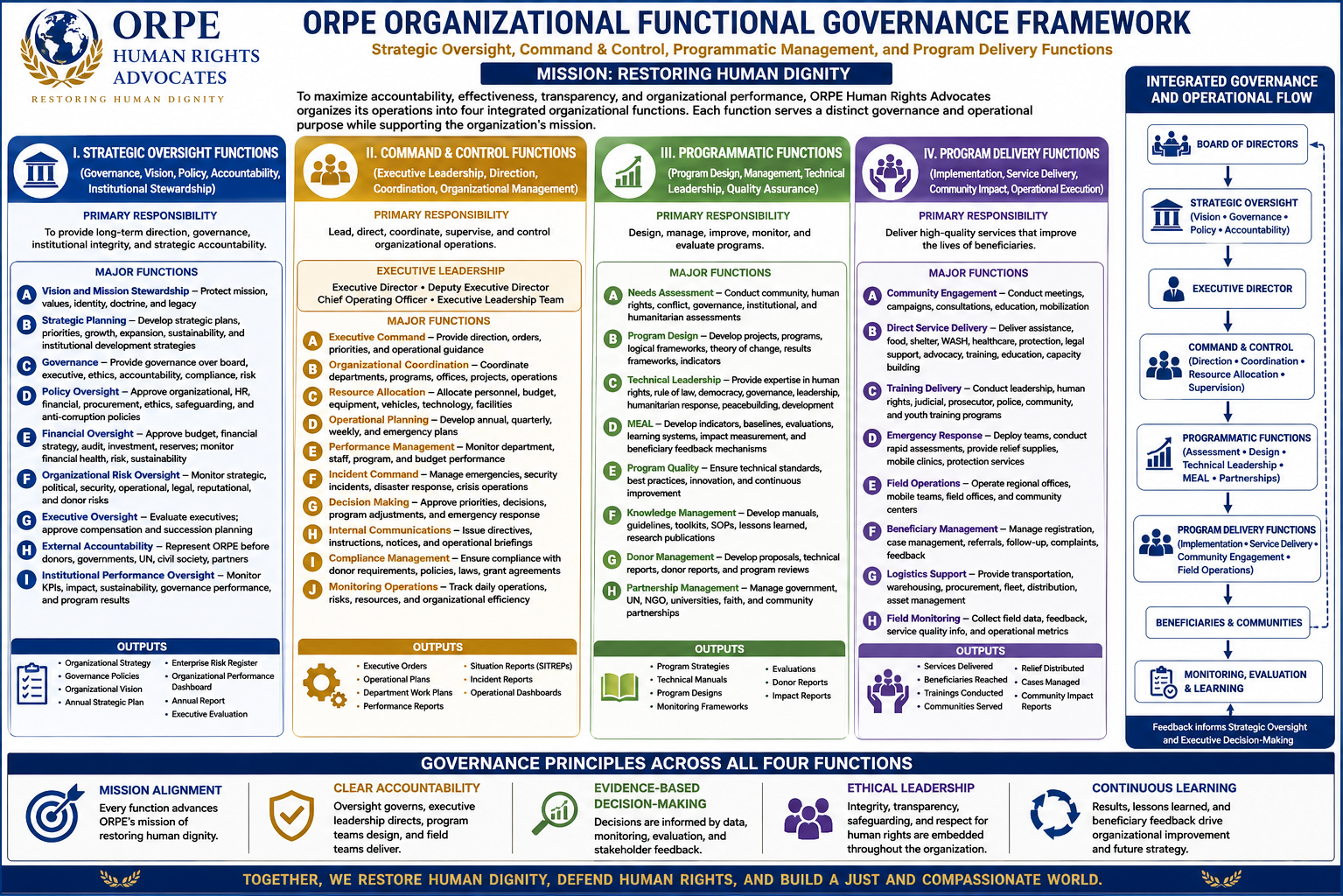
An operationally effective leadership team for Orpe Human Rights Advocates, structured in the following three integrated tiers:
-
Governance (oversight and legitimacy)
-
Executive leadership (from strategy into execution)
-
Programmatic & functional leadership (delivery of the five pillars)
This aligns with best-practice organizational architecture where the Board governs, the Executive Director leads, and functional heads implement programs.
Purpose:
Legitimacy, fiduciary oversight, donor confidence, and strategic direction
Functional Committees:
-
Audit & Risk Committee
-
Governance & Ethics Committee
-
Programs & Impact Committee
-
Resource Mobilization Committee
Core Roles:
-
Board Chair / President
-
Vice Chair
-
Secretary
-
Treasurer (Finance Oversight)
-
Independent Directors (Law, Human Rights, Diplomacy, Development, Theology)
Profile of People Needed:
-
International human rights lawyer
-
Former diplomat / UN or regional body official
-
Development finance expert
-
Faith-based leadership authority (aligned with ORPE doctrine)
-
Security / humanitarian operations expert
Why This Matter:
-
The Board sets policy, approves budgets, and ensures accountability, not day-to-day management .


A mission-integrated, execution-oriented Chief Executive Officer (CEO) / Executive Director (ED) role architecture that translates:
-
Restoring Human Dignity (mission)
-
Five Pillars (program structure)
-
Truth-Driven Leadership Doctrine (governance philosophy)
into clear, accountable duties tied to measurable outcomes.
The CEO/ED at ORPE serves as the chief steward of ORPE’s mission, responsible for:
-
Translating truth-driven doctrine into operational strategy, and into measurable impact
-
Ensuring all programs restore human dignity through the Five Pillars
-
Maintaining institutional integrity, donor compliance, and global credibility
PROGRAMMATIC LEADERSHIP (FIVE PILLARS OVERSIGHT)
The CEO ensures coherence, impact, and accountability across all five pillars:
1. Crisis Response & Humanitarian Action
-
Approve rapid response strategies
-
Ensure ethical, dignified delivery of emergency services
-
Oversee deployment readiness and crisis protocols
2. Justice & Rule of Law
-
Guide legal and institutional reform strategies
-
Ensure accountability mechanisms are credible and enforceable
-
Support strategic litigation and justice access initiatives
3. Democracy & Ethical Leadership
-
Champion truth-driven leadership models in governance systems
-
Oversee anti-corruption and civic engagement initiatives
-
Engage with political and institutional actors
4. Institutional Strengthening
-
Direct capacity-building strategies for governments and civil society
-
Ensure sustainability through systems reform and policy integration
5. Community Empowerment & Sustainable Development
-
Ensure programs are community-driven and inclusive
-
Promote long-term resilience and dignity restoration at grassroots level
Strategic Leadership Duties:
1. Mission Operationalization
-
Convert ORPE’s doctrine into strategic plans, program models, and measurable outcomes
-
Ensure all activities demonstrably contribute to restoration of human dignity
-
Define and enforce organizational theory of change
2. Organizational Strategy & Growth
-
Develop and execute multi-year global strategy
-
Identify expansion opportunities (countries, sectors, partnerships)
-
Position ORPE as a thought leader in human rights and ethical governance.
3. Doctrine Integration (Critical Differentiator)
-
Institutionalize Truth-Driven Leadership Doctrine across:
-
Programs
-
Staff conduct
-
Partnerships
-
-
Ensure doctrine is applied without compromising donor neutrality requirements
GOVERNANCE & BOARD RELATIONSHIP
1. Board Engagement
-
Serve as primary liaison to Board of Directors
-
Provide strategic updates, risk reports, and performance data
-
Implement Board-approved policies and decisions
2. Organizational Accountability
-
Ensure compliance with:
-
Internal governance manual
-
Donor requirements (USAID, UN, etc.)
-
-
Maintain transparency and ethical conduct across all operations
DONOR & EXTERNAL RELATIONS
1. Resource Mobilization
-
Lead fundraising strategy (USAID, foundations, multilateral donors)
-
Secure high-value grants and partnerships
-
Represent ORPE in donor negotiations
2. Strategic Partnerships
-
Build alliances with:
-
Governments
-
International organizations
-
Civil society networks
-
Position ORPE as a trusted implementation partner
OPERATIONAL OVERSIGHT
1. Financial Stewardship
-
Ensure responsible management of all funds
-
Approve budgets and oversee financial performance
-
Guarantee compliance with 2 CFR 200 and audit standards
2. Organizational Systems
-
Oversee HR, procurement, and operational systems
-
Ensure efficiency, scalability, and compliance
3. Risk Management
-
Maintain enterprise risk oversight
-
Ensure mitigation strategies for:
-
Security risks
-
Financial risks
-
Reputational risks
-
MEASUREMENT, IMPACT & LEARNING
1. Results Accountability (Critical for Donor)
-
Ensure all programs have:
-
Clear indicators
-
Baselines and targets
-
-
Review performance regularly against outcomes
2. Evidence-Based Decision Making
-
Use MEAL data to guide strategy adjustments
-
Promote adaptive management (CLA approach)
PEOPLE & CULTURE LEADERSHIP
1. Leadership of Senior Team
-
Recruit, develop, and manage senior leadership
-
Ensure alignment with mission and doctrine
2. Organizational Culture
Foster a culture of:
-
Integrity
-
Accountability
-
Service
-
Truth-driven leadership
KEY PERFORMANCE INDICATORS (CEO ACCOUNTABILITY)
The CEO is evaluated based on:
Impact
Measurable improvements in:
-
Justice access
-
Institutional performance
-
Community resilience
Financial
-
Funds raised vs targets
-
Budget execution efficiency
Compliance
-
Audit results
-
Donor compliance ratings
Organizational Growth
-
Geographic expansion
-
Partnerships established
ETHICS, SAFEGUARDING & DOCTRINAL INTEGRITY
1. Ethical Oversight
-
Enforce safeguarding policies (PSEA, anti-harassment)
-
Ensure protection of beneficiaries and staff
2. Doctrine Stewardship
-
Safeguard ORPE’s identity as a truth-driven organization
-
Ensure doctrine enhances; not compromises program effectiveness
GLOBAL REPRESENTATION
External Leadership
-
Represent ORPE at:
-
International forums
-
Donor meetings
-
Government engagements
-
-
Serve as the public face of ORPE
DECISION AUTHORITY
The CEO has authority to:
-
Approve operational decisions
-
Hire senior staff
-
Execute donor agreements
-
Allocate resources within Board-approved budgets
SUMMARY (WHAT MAKES THIS ROLE DISTINCT)
Unlike a standard NGO Executive Director, the ORPE CEO must:
-
Integrate faith-informed doctrine with secular donor systems
-
Lead across both crisis response and governance reform domains
-
Deliver measurable, donor-validated results
-
Maintain ethical and doctrinal integrity under complex conditions
Duty:
-
Oversees all five ORPE pillars
-
Ensures program coherence and results
Duty:
-
Finance, HR, procurement, compliance
-
Ensures donor-grade systems (e.g., 2 CFR 200 compliance)
A mission-integrated, execution-oriented Chief Executive Officer (CEO) / Executive Director (ED) role architecture that translates:
-
Restoring Human Dignity (mission)
-
Five Pillars (program structure)
-
Truth-Driven Leadership Doctrine (governance philosophy)
into clear, accountable duties tied to measurable outcomes.
The CEO/ED at ORPE serves as the chief steward of ORPE’s mission, responsible for:
-
Translating truth-driven doctrine into operational strategy, and into measurable impact
-
Ensuring all programs restore human dignity through the Five Pillars
-
Maintaining institutional integrity, donor compliance, and global credibility
PROGRAMMATIC LEADERSHIP (FIVE PILLARS OVERSIGHT)
The CEO ensures coherence, impact, and accountability across all five pillars:
1. Crisis Response & Humanitarian Action
-
Approve rapid response strategies
-
Ensure ethical, dignified delivery of emergency services
-
Oversee deployment readiness and crisis protocols
2. Justice & Rule of Law
-
Guide legal and institutional reform strategies
-
Ensure accountability mechanisms are credible and enforceable
-
Support strategic litigation and justice access initiatives
3. Democracy & Ethical Leadership
-
Champion truth-driven leadership models in governance systems
-
Oversee anti-corruption and civic engagement initiatives
-
Engage with political and institutional actors
4. Institutional Strengthening
-
Direct capacity-building strategies for governments and civil society
-
Ensure sustainability through systems reform and policy integration
5. Community Empowerment & Sustainable Development
-
Ensure programs are community-driven and inclusive
-
Promote long-term resilience and dignity restoration at grassroots level
Strategic Leadership Duties:
1. Mission Operationalization
-
Convert ORPE’s doctrine into strategic plans, program models, and measurable outcomes
-
Ensure all activities demonstrably contribute to restoration of human dignity
-
Define and enforce organizational theory of change
2. Organizational Strategy & Growth
-
Develop and execute multi-year global strategy
-
Identify expansion opportunities (countries, sectors, partnerships)
-
Position ORPE as a thought leader in human rights and ethical governance.
3. Doctrine Integration (Critical Differentiator)
-
Institutionalize Truth-Driven Leadership Doctrine across:
-
Programs
-
Staff conduct
-
Partnerships
-
-
Ensure doctrine is applied without compromising donor neutrality requirements
GOVERNANCE & BOARD RELATIONSHIP
1. Board Engagement
-
Serve as primary liaison to Board of Directors
-
Provide strategic updates, risk reports, and performance data
-
Implement Board-approved policies and decisions
2. Organizational Accountability
-
Ensure compliance with:
-
Internal governance manual
-
Donor requirements (USAID, UN, etc.)
-
-
Maintain transparency and ethical conduct across all operations
DONOR & EXTERNAL RELATIONS
1. Resource Mobilization
-
Lead fundraising strategy (USAID, foundations, multilateral donors)
-
Secure high-value grants and partnerships
-
Represent ORPE in donor negotiations
2. Strategic Partnerships
-
Build alliances with:
-
Governments
-
International organizations
-
Civil society networks
-
Position ORPE as a trusted implementation partner
OPERATIONAL OVERSIGHT
1. Financial Stewardship
-
Ensure responsible management of all funds
-
Approve budgets and oversee financial performance
-
Guarantee compliance with 2 CFR 200 and audit standards
2. Organizational Systems
-
Oversee HR, procurement, and operational systems
-
Ensure efficiency, scalability, and compliance
3. Risk Management
-
Maintain enterprise risk oversight
-
Ensure mitigation strategies for:
-
Security risks
-
Financial risks
-
Reputational risks
-
MEASUREMENT, IMPACT & LEARNING
1. Results Accountability (Critical for Donor)
-
Ensure all programs have:
-
Clear indicators
-
Baselines and targets
-
-
Review performance regularly against outcomes
2. Evidence-Based Decision Making
-
Use MEAL data to guide strategy adjustments
-
Promote adaptive management (CLA approach)
PEOPLE & CULTURE LEADERSHIP
1. Leadership of Senior Team
-
Recruit, develop, and manage senior leadership
-
Ensure alignment with mission and doctrine
2. Organizational Culture
Foster a culture of:
-
Integrity
-
Accountability
-
Service
-
Truth-driven leadership
KEY PERFORMANCE INDICATORS (CEO ACCOUNTABILITY)
The CEO is evaluated based on:
Impact
Measurable improvements in:
-
Justice access
-
Institutional performance
-
Community resilience
Financial
-
Funds raised vs targets
-
Budget execution efficiency
Compliance
-
Audit results
-
Donor compliance ratings
Organizational Growth
-
Geographic expansion
-
Partnerships established
ETHICS, SAFEGUARDING & DOCTRINAL INTEGRITY
1. Ethical Oversight
-
Enforce safeguarding policies (PSEA, anti-harassment)
-
Ensure protection of beneficiaries and staff
2. Doctrine Stewardship
-
Safeguard ORPE’s identity as a truth-driven organization
-
Ensure doctrine enhances; not compromises program effectiveness
GLOBAL REPRESENTATION
External Leadership
-
Represent ORPE at:
-
International forums
-
Donor meetings
-
Government engagements
-
-
Serve as the public face of ORPE
DECISION AUTHORITY
The CEO has authority to:
-
Approve operational decisions
-
Hire senior staff
-
Execute donor agreements
-
Allocate resources within Board-approved budgets
SUMMARY (WHAT MAKES THIS ROLE DISTINCT)
Unlike a standard NGO Executive Director, the ORPE CEO must:
-
Integrate faith-informed doctrine with secular donor systems
-
Lead across both crisis response and governance reform domains
-
Deliver measurable, donor-validated results
-
Maintain ethical and doctrinal integrity under complex conditions
A mission-integrated, execution-oriented Chief Executive Officer (CEO) / Executive Director (ED) role architecture that translates:
-
Restoring Human Dignity (mission)
-
Five Pillars (program structure)
-
Truth-Driven Leadership Doctrine (governance philosophy)
into clear, accountable duties tied to measurable outcomes.

PROGRAMMATIC LEADERSHIP (FIVE PILLARS OVERSIGHT)
The CEO ensures coherence, impact, and accountability across all five pillars:
1. Crisis Response & Humanitarian Action
-
Approve rapid response strategies
-
Ensure ethical, dignified delivery of emergency services
-
Oversee deployment readiness and crisis protocols
2. Justice & Rule of Law
-
Guide legal and institutional reform strategies
-
Ensure accountability mechanisms are credible and enforceable
-
Support strategic litigation and justice access initiatives
3. Democracy & Ethical Leadership
-
Champion truth-driven leadership models in governance systems
-
Oversee anti-corruption and civic engagement initiatives
-
Engage with political and institutional actors
4. Institutional Strengthening
-
Direct capacity-building strategies for governments and civil society
-
Ensure sustainability through systems reform and policy integration
5. Community Empowerment & Sustainable Development
-
Ensure programs are community-driven and inclusive
-
Promote long-term resilience and dignity restoration at grassroots level
Strategic Leadership Duties:
1. Mission Operationalization
-
Convert ORPE’s doctrine into strategic plans, program models, and measurable outcomes
-
Ensure all activities demonstrably contribute to restoration of human dignity
-
Define and enforce organizational theory of change
2. Organizational Strategy & Growth
-
Develop and execute multi-year global strategy
-
Identify expansion opportunities (countries, sectors, partnerships)
-
Position ORPE as a thought leader in human rights and ethical governance.
3. Doctrine Integration (Critical Differentiator)
-
Institutionalize Truth-Driven Leadership Doctrine across:
-
Programs
-
Staff conduct
-
Partnerships
-
-
Ensure doctrine is applied without compromising donor neutrality requirements
GOVERNANCE & BOARD RELATIONSHIP
1. Board Engagement
-
Serve as primary liaison to Board of Directors
-
Provide strategic updates, risk reports, and performance data
-
Implement Board-approved policies and decisions
2. Organizational Accountability
-
Ensure compliance with:
-
Internal governance manual
-
Donor requirements (USAID, UN, etc.)
-
-
Maintain transparency and ethical conduct across all operations
DONOR & EXTERNAL RELATIONS
1. Resource Mobilization
-
Lead fundraising strategy (USAID, foundations, multilateral donors)
-
Secure high-value grants and partnerships
-
Represent ORPE in donor negotiations
2. Strategic Partnerships
-
Build alliances with:
-
Governments
-
International organizations
-
Civil society networks
-
Position ORPE as a trusted implementation partner
OPERATIONAL OVERSIGHT
1. Financial Stewardship
-
Ensure responsible management of all funds
-
Approve budgets and oversee financial performance
-
Guarantee compliance with 2 CFR 200 and audit standards
2. Organizational Systems
-
Oversee HR, procurement, and operational systems
-
Ensure efficiency, scalability, and compliance
3. Risk Management
-
Maintain enterprise risk oversight
-
Ensure mitigation strategies for:
-
Security risks
-
Financial risks
-
Reputational risks
-
MEASUREMENT, IMPACT & LEARNING
1. Results Accountability (Critical for Donor)
-
Ensure all programs have:
-
Clear indicators
-
Baselines and targets
-
-
Review performance regularly against outcomes
2. Evidence-Based Decision Making
-
Use MEAL data to guide strategy adjustments
-
Promote adaptive management (CLA approach)
PEOPLE & CULTURE LEADERSHIP
1. Leadership of Senior Team
-
Recruit, develop, and manage senior leadership
-
Ensure alignment with mission and doctrine
2. Organizational Culture
Foster a culture of:
-
Integrity
-
Accountability
-
Service
-
Truth-driven leadership
KEY PERFORMANCE INDICATORS (CEO ACCOUNTABILITY)
The CEO is evaluated based on:
Impact
Measurable improvements in:
-
Justice access
-
Institutional performance
-
Community resilience
Financial
-
Funds raised vs targets
-
Budget execution efficiency
Compliance
-
Audit results
-
Donor compliance ratings
Organizational Growth
-
Geographic expansion
-
Partnerships established
ETHICS, SAFEGUARDING & DOCTRINAL INTEGRITY
1. Ethical Oversight
-
Enforce safeguarding policies (PSEA, anti-harassment)
-
Ensure protection of beneficiaries and staff
2. Doctrine Stewardship
-
Safeguard ORPE’s identity as a truth-driven organization
-
Ensure doctrine enhances; not compromises program effectiveness
GLOBAL REPRESENTATION
External Leadership
-
Represent ORPE at:
-
International forums
-
Donor meetings
-
Government engagements
-
-
Serve as the public face of ORPE
DECISION AUTHORITY
The CEO has authority to:
-
Approve operational decisions
-
Hire senior staff
-
Execute donor agreements
-
Allocate resources within Board-approved budgets
SUMMARY (WHAT MAKES THIS ROLE DISTINCT)
Unlike a standard NGO Executive Director, the ORPE CEO must:
-
Integrate faith-informed doctrine with secular donor systems
-
Lead across both crisis response and governance reform domains
-
Deliver measurable, donor-validated results
-
Maintain ethical and doctrinal integrity under complex conditions
These are Director-level roles aligned to ORPE’s five pillars + institutional backbone.
Results framework, indicators, impact verification
Essential for donor credibility
USAID, UN, governments, private donors
Strategic alliances
Produces doctrine, policy briefs, global advocacy
Anchors ORPE’s “truth-driven” intellectual framework
Branding, media, campaigns
Narrative control (critical for fundraising)
Emergency response systems
Field deployment teams
Protection and rapid intervention
Governance reform
Leadership training (truth-driven leadership doctrine)
Anti-corruption initiatives
Legal reform programs
Strategic litigation
Accountability mechanisms
Government and civil society capacity
Public administration reform
Systems strengthening
Grassroots programs
Livelihoods and resilience
Community-led development models
Duty:
-
Budgeting
-
Audits
-
Donor compliance
Recruitment, Safeguarding
Training
Proposal development
Regulatory compliance (USAID, World Bank, EU)
Staff safety
Operations in fragile/conflict zones
Data security
Digital monitoring systems
Restorative Yoga
Restorative yoga focuses on holding passive poses for extended periods, promoting relaxation and reducing stress by engaging the parasympathetic nervous system.
Duration: 45 minutes
Barre Fusion
This class is held in a barre fusion style, integrating ballet-inspired movements, Pilates, and strength training to sculpt and tone muscles, emphasizing flexibility and balance.
Duration: 1 hour
Reformer Pilates
This class is conducted on the reformer machine and focuses on core strength, flexibility, and overall muscle tone through controlled movements and resistance.
Duration: 1 hour

-
Influence
-
Credibility
-
Access to funding networks
An operationally effective leadership team for Orpe Human Rights Advocates, structured in the following three integrated tiers:
-
Governance (oversight and legitimacy)
-
Executive leadership (from strategy into execution)
-
Programmatic & functional leadership (delivery of the five pillars)
This aligns with best-practice organizational architecture where the Board governs, the Executive Director leads, and functional heads implement programs.
Purpose:
Legitimacy, fiduciary oversight, donor confidence, and strategic direction
Functional Committees:
-
Audit & Risk Committee
-
Governance & Ethics Committee
-
Programs & Impact Committee
-
Resource Mobilization Committee
Core Roles:
-
Board Chair / President
-
Vice Chair
-
Secretary
-
Treasurer (Finance Oversight)
-
Independent Directors (Law, Human Rights, Diplomacy, Development, Theology)
Profile of People Needed:
-
International human rights lawyer
-
Former diplomat / UN or regional body official
-
Development finance expert
-
Faith-based leadership authority (aligned with ORPE doctrine)
-
Security / humanitarian operations expert
Why This Matter:
-
The Board sets policy, approves budgets, and ensures accountability, not day-to-day management .

A mission-integrated, execution-oriented Chief Executive Officer (CEO) / Executive Director (ED) role architecture that translates:
-
Restoring Human Dignity (mission)
-
Five Pillars (program structure)
-
Truth-Driven Leadership Doctrine (governance philosophy)
into clear, accountable duties tied to measurable outcomes.
The CEO/ED at ORPE serves as the chief steward of ORPE’s mission, responsible for:
-
Translating truth-driven doctrine into operational strategy, and into measurable impact
-
Ensuring all programs restore human dignity through the Five Pillars
-
Maintaining institutional integrity, donor compliance, and global credibility
PROGRAMMATIC LEADERSHIP (FIVE PILLARS OVERSIGHT)
The CEO ensures coherence, impact, and accountability across all five pillars:
1. Crisis Response & Humanitarian Action
-
Approve rapid response strategies
-
Ensure ethical, dignified delivery of emergency services
-
Oversee deployment readiness and crisis protocols
2. Justice & Rule of Law
-
Guide legal and institutional reform strategies
-
Ensure accountability mechanisms are credible and enforceable
-
Support strategic litigation and justice access initiatives
3. Democracy & Ethical Leadership
-
Champion truth-driven leadership models in governance systems
-
Oversee anti-corruption and civic engagement initiatives
-
Engage with political and institutional actors
4. Institutional Strengthening
-
Direct capacity-building strategies for governments and civil society
-
Ensure sustainability through systems reform and policy integration
5. Community Empowerment & Sustainable Development
-
Ensure programs are community-driven and inclusive
-
Promote long-term resilience and dignity restoration at grassroots level
Strategic Leadership Duties:
1. Mission Operationalization
-
Convert ORPE’s doctrine into strategic plans, program models, and measurable outcomes
-
Ensure all activities demonstrably contribute to restoration of human dignity
-
Define and enforce organizational theory of change
2. Organizational Strategy & Growth
-
Develop and execute multi-year global strategy
-
Identify expansion opportunities (countries, sectors, partnerships)
-
Position ORPE as a thought leader in human rights and ethical governance.
3. Doctrine Integration (Critical Differentiator)
-
Institutionalize Truth-Driven Leadership Doctrine across:
-
Programs
-
Staff conduct
-
Partnerships
-
-
Ensure doctrine is applied without compromising donor neutrality requirements
GOVERNANCE & BOARD RELATIONSHIP
1. Board Engagement
-
Serve as primary liaison to Board of Directors
-
Provide strategic updates, risk reports, and performance data
-
Implement Board-approved policies and decisions
2. Organizational Accountability
-
Ensure compliance with:
-
Internal governance manual
-
Donor requirements (USAID, UN, etc.)
-
-
Maintain transparency and ethical conduct across all operations
DONOR & EXTERNAL RELATIONS
1. Resource Mobilization
-
Lead fundraising strategy (USAID, foundations, multilateral donors)
-
Secure high-value grants and partnerships
-
Represent ORPE in donor negotiations
2. Strategic Partnerships
-
Build alliances with:
-
Governments
-
International organizations
-
Civil society networks
-
Position ORPE as a trusted implementation partner
OPERATIONAL OVERSIGHT
1. Financial Stewardship
-
Ensure responsible management of all funds
-
Approve budgets and oversee financial performance
-
Guarantee compliance with 2 CFR 200 and audit standards
2. Organizational Systems
-
Oversee HR, procurement, and operational systems
-
Ensure efficiency, scalability, and compliance
3. Risk Management
-
Maintain enterprise risk oversight
-
Ensure mitigation strategies for:
-
Security risks
-
Financial risks
-
Reputational risks
-
MEASUREMENT, IMPACT & LEARNING
1. Results Accountability (Critical for Donor)
-
Ensure all programs have:
-
Clear indicators
-
Baselines and targets
-
-
Review performance regularly against outcomes
2. Evidence-Based Decision Making
-
Use MEAL data to guide strategy adjustments
-
Promote adaptive management (CLA approach)
PEOPLE & CULTURE LEADERSHIP
1. Leadership of Senior Team
-
Recruit, develop, and manage senior leadership
-
Ensure alignment with mission and doctrine
2. Organizational Culture
Foster a culture of:
-
Integrity
-
Accountability
-
Service
-
Truth-driven leadership
KEY PERFORMANCE INDICATORS (CEO ACCOUNTABILITY)
The CEO is evaluated based on:
Impact
Measurable improvements in:
-
Justice access
-
Institutional performance
-
Community resilience
Financial
-
Funds raised vs targets
-
Budget execution efficiency
Compliance
-
Audit results
-
Donor compliance ratings
Organizational Growth
-
Geographic expansion
-
Partnerships established
ETHICS, SAFEGUARDING & DOCTRINAL INTEGRITY
1. Ethical Oversight
-
Enforce safeguarding policies (PSEA, anti-harassment)
-
Ensure protection of beneficiaries and staff
2. Doctrine Stewardship
-
Safeguard ORPE’s identity as a truth-driven organization
-
Ensure doctrine enhances; not compromises program effectiveness
GLOBAL REPRESENTATION
External Leadership
-
Represent ORPE at:
-
International forums
-
Donor meetings
-
Government engagements
-
-
Serve as the public face of ORPE
DECISION AUTHORITY
The CEO has authority to:
-
Approve operational decisions
-
Hire senior staff
-
Execute donor agreements
-
Allocate resources within Board-approved budgets
SUMMARY (WHAT MAKES THIS ROLE DISTINCT)
Unlike a standard NGO Executive Director, the ORPE CEO must:
-
Integrate faith-informed doctrine with secular donor systems
-
Lead across both crisis response and governance reform domains
-
Deliver measurable, donor-validated results
-
Maintain ethical and doctrinal integrity under complex conditions
Duty:
-
Oversees all five ORPE pillars
-
Ensures program coherence and results
Duty:
-
Finance, HR, procurement, compliance
-
Ensures donor-grade systems (e.g., 2 CFR 200 compliance)
These are Director-level roles aligned to ORPE’s five pillars + institutional backbone.
Results framework, indicators, impact verification
Essential for donor credibility
USAID, UN, governments, private donors
Strategic alliances
Produces doctrine, policy briefs, global advocacy
Anchors ORPE’s “truth-driven” intellectual framework
Branding, media, campaigns
Narrative control (critical for fundraising)
Emergency response systems
Field deployment teams
Protection and rapid intervention
Governance reform
Leadership training (truth-driven leadership doctrine)
Anti-corruption initiatives
Legal reform programs
Strategic litigation
Accountability mechanisms
Government and civil society capacity
Public administration reform
Systems strengthening
Grassroots programs
Livelihoods and resilience
Community-led development models
Duty:
-
Budgeting
-
Audits
-
Donor compliance
Recruitment, Safeguarding
Training
Proposal development
Regulatory compliance (USAID, World Bank, EU)
Staff safety
Operations in fragile/conflict zones
Data security
Digital monitoring systems
Restorative Yoga
Restorative yoga focuses on holding passive poses for extended periods, promoting relaxation and reducing stress by engaging the parasympathetic nervous system.
Duration: 45 minutes
Barre Fusion
This class is held in a barre fusion style, integrating ballet-inspired movements, Pilates, and strength training to sculpt and tone muscles, emphasizing flexibility and balance.
Duration: 1 hour
Reformer Pilates
This class is conducted on the reformer machine and focuses on core strength, flexibility, and overall muscle tone through controlled movements and resistance.
Duration: 1 hour
-
Influence
-
Credibility
-
Access to funding networks